
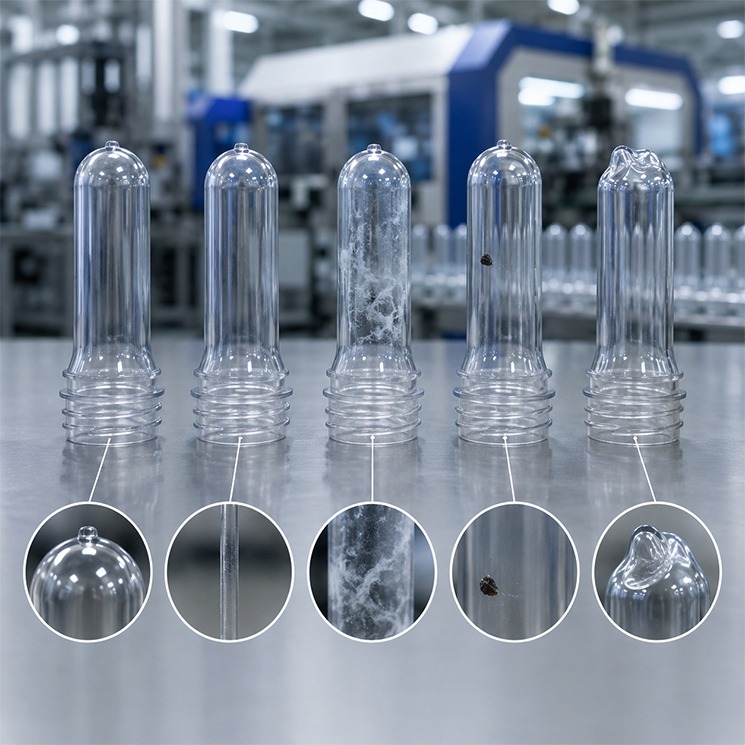
A PET preform may look like a simple intermediate component, but it plays an important role in the performance of the final PET bottle.
Before the bottle is formed through stretch blow moulding, the preform already determines key characteristics such as weight, geometry, neck dimensions and material distribution. Any variation in these areas can influence how the PET behaves during the bottle-making process.
This is why understanding preform defects is important for both PET bottle manufacturers and packaging brands.
What Is a PET Preform Defect?
A PET preform defect is any deviation from the required appearance, dimensions, weight, material distribution or physical characteristics of the preform.
Some defects are visible during inspection, while others may only become apparent during stretch blow moulding or in the finished bottle.
The cause can originate at different stages—from resin handling and drying to injection moulding, cooling and mould maintenance.
1. Black Specks or Dark Particles
Black specks appear as small dark particles or discoloured areas within the preform.
Possible causes include:
* Material degradation
* Excessive residence time
* Contamination
* Degraded PET in the injection system
* Poor equipment cleanliness
Because PET can degrade when exposed to excessive heat for extended periods, controlling processing conditions and residence time is important.
2. Haze or Cloudiness
Haze can affect the clarity and appearance of a PET preform.
Possible causes include:
* Insufficient resin drying
* Moisture-related degradation
* Incorrect processing conditions
* Excessive crystallisation
* Contamination
PET is hygroscopic, meaning it can absorb moisture from the environment. Proper resin drying before processing is therefore an important part of preform manufacturing.
3. Short Shots
A short shot occurs when the mould cavity is not completely filled, resulting in incomplete preform geometry.
Possible causes include:
* Insufficient injection pressure
* Incorrect injection speed
* Inadequate melt temperature
* Material flow restrictions
* Incorrect process settings
A short shot can affect both the dimensions and subsequent performance of the preform.
4. Flash
Flash is excess PET extending beyond the intended moulded geometry, commonly around the mould parting line.
It may be associated with:
* Excessive injection pressure
* Mould wear or damage
* Incorrect clamping conditions
* Mould misalignment
* Process instability
Flash can affect dimensional consistency and may require additional inspection or corrective action.
5. Dimensional Variation
Consistency in preform dimensions is particularly important around the neck finish, which must interface correctly with the closure and filling system.
Variation can occur in:
* Neck dimensions
* Preform length
* Weight
* Wall thickness
* Gate area
Potential contributors include mould condition, process settings, material variation and cooling behaviour.
6. Gate-Related Defects
The gate is where molten PET enters the mould cavity, making it an important area for inspection.
Issues can include:
* Uneven gate appearance
* Excessive gate vestige
* Gate protrusion
* Cracking or damage
* Improper gate formation
Gate quality can affect the appearance of the preform and its behaviour during subsequent stretch blow moulding.
Why Preform Quality Matters to the Final Bottle
The preform becomes the starting material for the finished PET bottle.
During stretch blow moulding, it is reheated and stretched in different directions. Its weight, geometry, wall distribution and material characteristics influence how the material distributes across the final bottle.
For example, inconsistent material distribution can contribute to uneven bottle walls, while variation in the neck area can create downstream compatibility issues.
Therefore, preform inspection should not be considered separately from bottle performance.
How Can Preform Defects Be Reduced?
Consistent preform quality starts with controlling the complete manufacturing process.
Key areas include:
- Resin handling: Proper storage and handling help minimise contamination and moisture exposure.
- Resin drying: Correct drying is essential because moisture can affect PET during melt processing.
- Injection moulding: Temperature, pressure, injection speed, cooling and residence time need to be controlled according to the product and process requirements.
- Mould maintenance: Mould alignment, cavities, gates and cooling systems can influence preform consistency.
- Quality inspection: Regular inspection helps identify deviations before they become larger production issues.
What Should PET Buyers Look For?
When selecting a PET preform supplier, price and preform weight should not be the only considerations.
Brands and bottle manufacturers should also evaluate:
* Dimensional consistency
* Neck-finish accuracy
* Weight tolerance
* Visual quality
* Gate quality
* Material consistency
* Process controls
* Quality inspection
* Batch-to-batch consistency
A preform should not only meet a specification on paper. It should consistently perform in the customer’s bottle-production process.
From Preform Quality to Bottle Performance
A PET preform is the foundation of the bottle-making process. Its quality can influence how efficiently and consistently the final bottle is produced.
Understanding common defects therefore helps manufacturers troubleshoot problems earlier and helps packaging buyers make better decisions when evaluating suppliers.
At Chemco Group, PET preform manufacturing focuses on process control, quality consistency and the requirements of the final PET packaging application.
Because better PET bottles start with better-controlled preforms.