
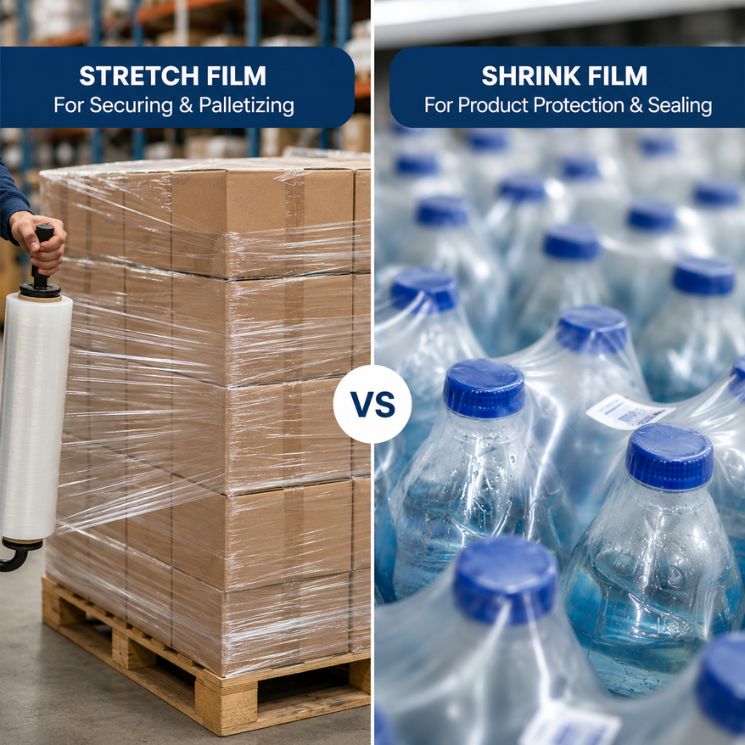
In industrial and commercial packaging, selecting the right protective film is essential for ensuring product integrity, operational efficiency, and cost optimisation. Two of the most commonly used packaging materials—stretch film and shrink film—are often mistaken for one another due to their similar appearance.
However, despite both being polymer-based packaging films, they are designed for entirely different applications.
Understanding the differences between stretch film and shrink film helps manufacturers, distributors, and brand owners choose the most suitable solution based on their packaging requirements.
What is Stretch Film?
Stretch film is a highly stretchable plastic film used primarily for securing and stabilising products during storage and transportation.
The film is applied by stretching it around products or palletised loads, allowing its elastic recovery to create a tight holding force. This eliminates the need for adhesives or heat during application.
Stretch film is widely used across logistics, warehousing, manufacturing, and distribution operations to minimise load movement and improve transport stability.
Typical Applications
- Pallet wrapping
- Warehouse storage
- Distribution and logistics
- Unitising multiple cartons
- Protection against dust and moisture during transit
What is Shrink Film?
Shrink film is a polymer film that contracts tightly around a product when exposed to controlled heat.
After the product is wrapped, it passes through a heat tunnel or is treated with a heat gun, causing the film to shrink uniformly around the product.
Shrink film is primarily used for retail and consumer packaging where product presentation, tamper evidence, and protection are equally important.
Typical Applications
- Beverage multipacks
- Food and bakery products
- Personal care and cosmetic products
- Consumer goods
- Electronics
- Pharmaceutical packaging
Stretch Film vs. Shrink Film: A Comparison
| Parameter | Stretch Film | Shrink Film |
|---|---|---|
| Application Method | Applied by stretching around the load | Applied loosely and shrunk using heat |
| Heat Requirement | Not required | Required |
| Primary Purpose | Load stabilisation and transport protection | Product containment and retail presentation |
| Typical Use | Pallets, cartons and industrial loads | Individual products and multipacks |
| Tamper Evidence | Limited | Excellent |
| Packaging Appearance | Secures the load without conforming tightly to product shape | Conforms closely to the product for a clean finish |
Packaging Appearance Secures the load without conforming tightly to product shape Conforms closely to the product for a clean finish
Which Packaging Solution is Right for Your Business?
The choice between stretch film and shrink film depends on the intended application rather than the material itself.
If the objective is to secure pallet loads, improve transport stability, and protect goods throughout the supply chain, stretch film is the preferred solution.
If the requirement is to provide a neat retail appearance, product containment, and tamper-evident packaging, shrink film is the more suitable option.
In many industries, both films complement one another. Products may first be shrink wrapped for retail presentation before cartons are palletised and secured using stretch film for transportation.
Making the Right Packaging Decision
Choosing the appropriate packaging solution involves more than comparing materials. Factors such as product dimensions, load stability, transportation conditions, automation requirements, sustainability objectives, and overall packaging efficiency should all be considered.
As packaging continues to evolve, businesses are increasingly looking for solutions that not only protect products but also improve operational performance and optimise material usage.
Understanding the distinct roles of stretch film and shrink film enables businesses to make informed packaging decisions that support both product protection and supply chain efficiency.
Final Thought
Although stretch film and shrink film may appear similar, they are designed to solve different packaging challenges.
Selecting the right film ensures better product protection, improved handling efficiency, and enhanced packaging performance throughout the product’s journey—from production to the end user.