When developing a new beverage, most discussions revolve around formulation, flavour, branding, and shelf appeal. However, one decision that can significantly influence product quality, shelf life, and packaging performance is the filling process itself.
Whether a beverage is hot filled or cold filled affects much more than production. It influences bottle design, closure selection, packaging performance, and the overall requirements of the packaging system.
For beverage brands, understanding the differences between these two filling methods is an important step in selecting the right packaging solution for their product.
Understanding Hot Fill and Cold Fill Packaging
The primary difference between hot fill and cold fill packaging lies in the temperature at which the product is filled into the container.
Hot Fill Packaging
In a hot fill process, the product is heated before filling and is typically introduced into the container at elevated temperatures. The heat treatment helps reduce microbial activity and supports product preservation.
Hot fill packaging is commonly used for:
- Fruit juices
- Juice drinks
- Ready-to-drink teas
- Sports and functional beverages
- Certain sauces and liquid food applications
Once the product is filled and sealed, it gradually cools inside the package. This cooling process creates packaging design considerations that must be addressed during bottle development.
Cold Fill Packaging
In a cold fill process, the product is filled at ambient or chilled temperatures.
Cold fill packaging is widely used for:
- Bottled water
- Carbonated soft drinks
- Energy drinks
- Certain dairy and plant-based beverages
- Aseptically processed beverages
Because the package is not exposed to the same thermal conditions as hot-fill applications, the packaging requirements are often different.
Hot Fill vs. Cold Fill: Key Differences
Hot Fill Packaging
- Product is filled at elevated temperatures
- Commonly used for juices, teas, functional beverages, and selected liquid food products
- Packaging must withstand thermal stress and vacuum forces created during cooling
- Bottle and closure design are critical for maintaining package integrity
- Often used for products intended for ambient storage
Cold Fill Packaging
- Product is filled at ambient or chilled temperatures
- Commonly used for bottled water, carbonated beverages, energy drinks, and aseptic products
- Packaging design focuses on product protection, pressure management, and material optimization
- Standard closure systems are commonly used depending on product requirements
- Shelf-life performance depends on formulation, processing method, and storage conditions
How the Filling Process Influences Bottle Design
The filling process directly affects how a bottle performs during production, transportation, storage, and consumer use.
Bottle Design for Hot Fill Applications
As a hot-filled product cools after sealing, the liquid and headspace inside the package contract, creating a vacuum within the bottle.
To accommodate these conditions, bottles intended for hot-fill applications may incorporate:
- Heat-resistant bottle designs
- Reinforced material distribution
- Vacuum panels or vacuum-absorbing design features
- Closure systems developed specifically for hot-fill conditions
These features help maintain the bottle’s appearance and performance throughout its intended shelf life.
Bottle Design for Cold Fill Applications
Cold-fill bottles do not experience the same temperature-related stresses during filling.
Depending on the product category, packaging design may focus on:
- Lightweighting opportunities
- Carbonation retention
- Product protection
- Transportation performance
- Material efficiency
For carbonated beverages, bottle design must also accommodate the internal pressure generated by dissolved carbon dioxide.
PET: A Versatile Material for Beverage Packaging
PET continues to be one of the most widely used materials in beverage packaging due to its combination of strength, clarity, durability, and lightweight properties.
Depending on the application, PET bottles can be engineered to meet the performance requirements of both hot-fill and cold-fill products. This versatility has made PET a preferred packaging material across a wide range of beverage categories, from bottled water and soft drinks to juices and functional beverages.
In addition to its performance benefits, PET is also recyclable and plays an important role in advancing circular packaging initiatives across the industry.
Why the Bottle Neck Matters More Than You Think
When discussing bottle design, attention is often focused on the body of the package. However, the neck finish is equally important to overall packaging performance.
The neck finish must be compatible with the closure system, filling process, and product requirements.
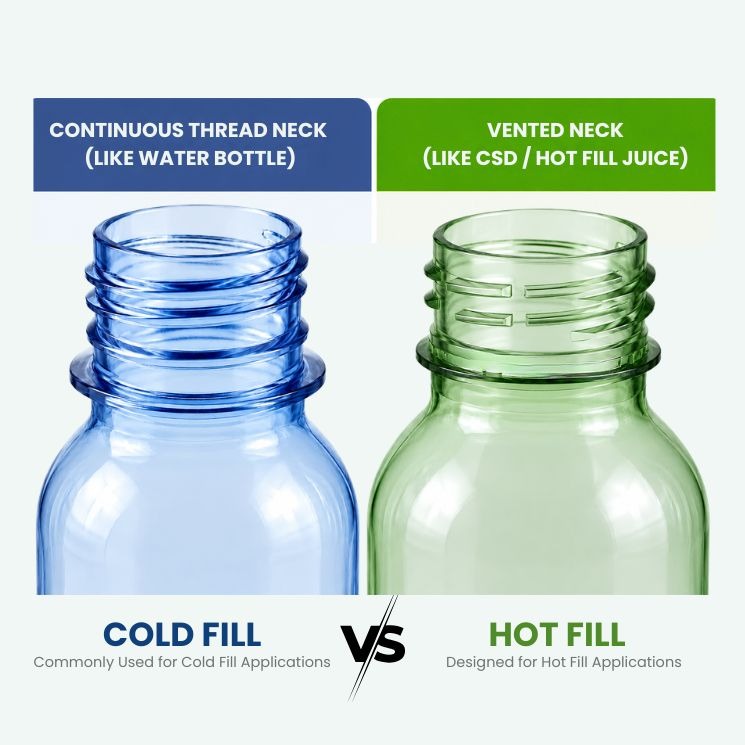
For many cold-fill applications, standard continuous-thread neck finishes provide reliable sealing performance.
Hot-fill applications may require neck finishes and closure systems specifically designed to accommodate filling and cooling conditions. In some cases, manufacturers utilize vented neck finishes or other engineered closure solutions that help manage steam release and pressure changes during the capping process.
Although consumers rarely notice these design features, they contribute significantly to package integrity, seal performance, and product quality.
Factors to Consider When Selecting a Filling Process
The decision between hot fill and cold fill should be based on a combination of product, processing, and packaging requirements.
Key Considerations
- Product formulation
- Acidity levels
- Shelf-life expectations
- Distribution and storage conditions
- Production capabilities
- Packaging design requirements
- Sustainability objectives
A packaging solution that works well for a carbonated beverage may not be suitable for a hot-filled juice product. Evaluating these requirements early in the development process can help prevent packaging challenges later on.
Conclusion
Hot fill and cold fill packaging each offer unique advantages, and the right choice depends on the specific needs of the product.
The filling process influences everything from bottle design and closure compatibility to shelf life and packaging performance. Understanding these requirements early allows brands to develop packaging solutions that support product quality, operational efficiency, and consumer expectations.
As beverage innovation continues to evolve, selecting the appropriate packaging system remains an important part of bringing successful products to market.
Looking for the Right Beverage Packaging Solution?
Choosing between hot fill and cold fill packaging is only one part of the packaging development process. Bottle design, closure compatibility, product requirements, and manufacturing conditions all play a role in determining the most effective solution.
At Chemco, we offer packaging solutions for a wide range of beverage applications, including both hot-fill and cold-fill products. Our team works closely with brands to understand their requirements and recommend packaging solutions that align with performance, production, and market goals.
Get in touch with our team to discuss your beverage packaging requirements and discover the right solution for your next product launch.