
Have you ever wondered what happens to a PET bottle after you’ve finished using it?
For many, it’s simply thrown into a recycling bin and forgotten. But that’s only the beginning of its journey.
When collected and recycled correctly, a PET bottle doesn’t become waste—it becomes a valuable resource that can be transformed into new products, reducing the need for virgin plastic and supporting a more circular economy.
As conversations around sustainability continue to grow, understanding the lifecycle of packaging has never been more important.
Why PET Stands Out
PET (Polyethylene Terephthalate) is one of the world’s most widely used packaging materials—and for good reason. It is lightweight, durable, food-safe, and highly recyclable.
Unlike many materials that lose quality after recycling, PET can be processed into recycled PET (rPET) and used in a variety of applications, giving the material multiple lives instead of just one.
This ability to stay in circulation makes PET an important part of the transition towards more sustainable packaging.
The Journey of a PET Bottle
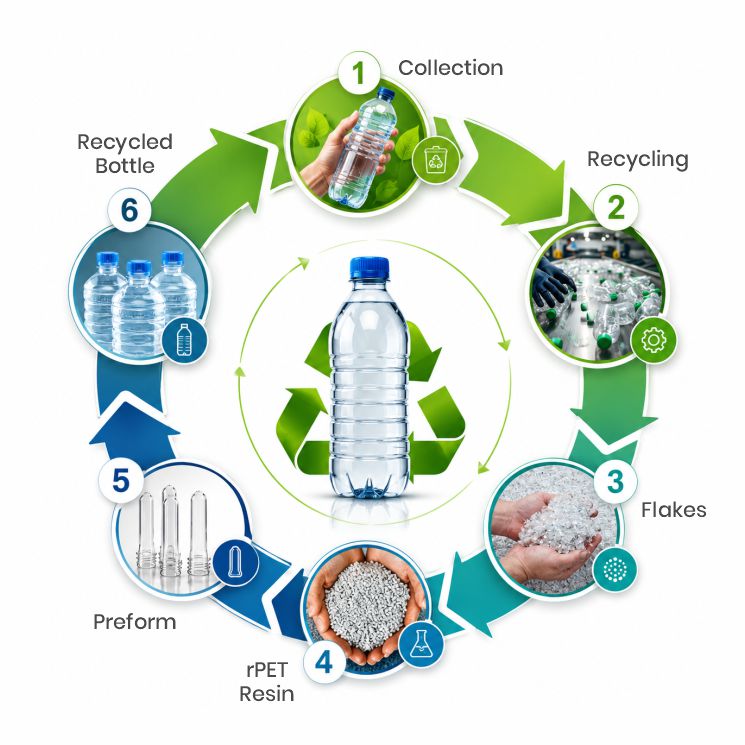
A PET bottle’s lifecycle doesn’t end after its first use. With the right collection and recycling systems in place, it can continue creating value.
Step 1: Collection
Once used, PET bottles are collected through waste collection systems, recycling initiatives, and collection networks.
Step 2: Sorting & Recycling
The collected bottles are sorted, cleaned, and processed into PET flakes or pellets. These recycled materials become the raw material for manufacturing new products.
Step 3: A New Beginning
Recycled PET can be transformed into a wide range of applications, including:
- New PET bottles
- Food-grade packaging
- Textile fibres
- Industrial packaging
- Reusable transport and packaging solutions
Instead of ending up in landfills, PET continues its journey in a new form.
Circular Packaging Starts with Better Design
Recycling is only one part of the equation.
Packaging designed with recyclability in mind makes it easier to recover valuable materials and return them to the manufacturing cycle. Choosing recyclable materials, reducing unnecessary material combinations, and increasing the use of recycled content are all important steps towards building a circular packaging ecosystem.
When products are designed for circularity, they create value long after their first use.
India’s Growing PET Recycling Ecosystem
India has emerged as one of the global leaders in PET recycling, supported by an extensive network of collectors, recyclers, and manufacturers.
Today, an estimated 9 out of every 10 PET bottles in India are recycled, demonstrating what’s possible when materials are valued and effective collection systems are in place.
This progress highlights an important principle: when materials have value, they are more likely to be collected, recycled, and reintroduced into the economy instead of becoming waste.
Every Bottle Has a Future
The journey of a PET bottle doesn’t have to end after a single use.
With thoughtful design, efficient collection systems, and advanced recycling technologies, PET can remain in circulation for years—reducing waste, conserving resources, and supporting a more circular economy.
As sustainability becomes a shared responsibility across manufacturers, brands, recyclers, policymakers, and consumers, one thing is becoming increasingly clear:
The future of packaging isn’t about using less plastic. It’s about using plastic more responsibly.
Every bottle collected is an opportunity to create something new.
Every recycled bottle is a step towards a more circular future.
Because in a circular economy, waste isn’t the end of the story—it’s the beginning of the next one.