
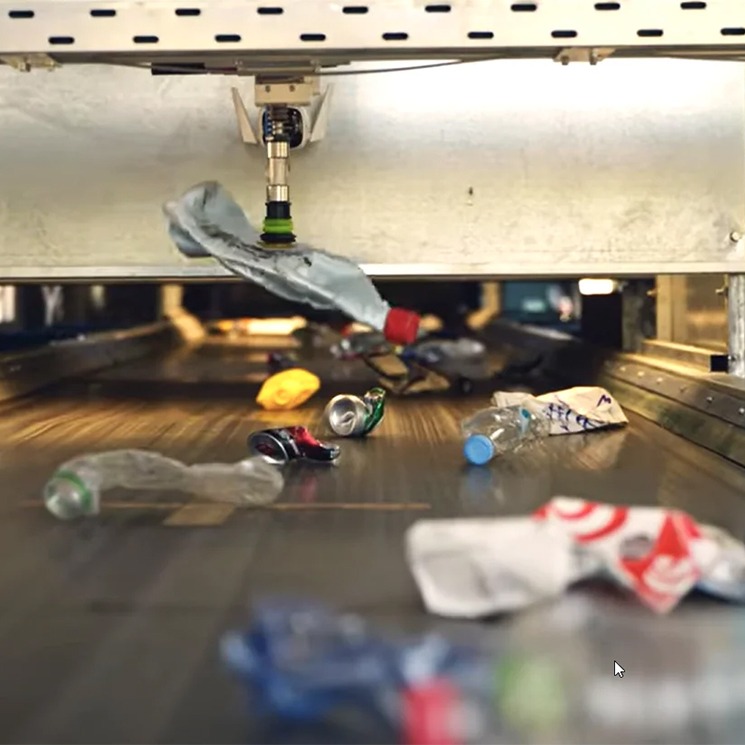
The rigid packaging industry is undergoing a technological revolution, driven by the increasing demand for sustainable solutions and artificial intelligence (AI)-driven automation. AI is redefining recycling efficiency, particularly in the sorting process, enabling a high-purity, circular economy for rigid plastics. As industries transition to higher rPET content, AI-powered solutions are essential to maintaining regulatory compliance, operational efficiency, and material quality.
The Challenge of High-Purity rPET Production
Producing food-grade recycled PET (rPET) requires a highly precise sorting of post-consumer PET bottles, ensuring that only food-contact approved plastics are reprocessed. Contamination from non-food PET, coloured plastics, and foreign polymers significantly impacts the safety, performance, and regulatory compliance of rPET. Traditional sorting methods often struggle with accuracy and scalability, making AI-based automation a game-changing solution.
AI-Driven Sorting: A Technological Breakthrough
AI-powered sorting systems analyse bottle characteristics in real-time, dramatically improving sorting precision. Advanced machine learning algorithms and near-infrared (NIR) detection enable:
- Polymer Identification – Distinguishing PET from other plastics such as HDPE and PP.
- Colour Sorting – Enhancing stream efficiency by accurately separating clear, blue, and green PET bottles.
- Food vs. Non-Food Differentiation – Ensuring compliance with food-contact safety standards by eliminating non-food PET contamination.
These advancements significantly improve the quality of rPET feedstock, enabling the production of high-IV, food-grade recycled materials suitable for beverage bottles, pharma, and food packaging applications.
Optimising rPET Production with AI
The adoption of AI-powered sorters offers tangible benefits:
- Unmatched Sorting Accuracy – Achieving up to 98-100% purity in post-consumer PET bottle separation.
- Regulatory Compliance – Aligning with EFSA guidelines, which mandate that food-grade rPET feedstock contains no more than 5% non-food PET bottles. Future FSSAI regulations in India are expected to adopt similar benchmarks.
- Scalability & Efficiency – AI enables high-speed processing of large waste volumes, increasing throughput while reducing manual intervention.
- Enhanced rPET Quality – AI-driven precision sorting ensures that food-grade rPET retains its strength, clarity, and compliance with packaging performance standards.
AI’s Growing Role in India’s Recycling Industry
AI-powered recycling is gaining traction globally, with Indian, European, and Chinese manufacturers pioneering the development of automated sorting systems. Given India’s 30% rPET content mandate in packaging by 2025-26, implementing high-efficiency AI sorting solutions will be critical in meeting sustainability goals, reducing virgin PET dependency, and strengthening domestic recycling infrastructure.
The Future of AI in Rigid Plastic Recycling
AI continues to evolve, enhancing sorting accuracy, adaptability, and efficiency. Future advancements will refine the ability to identify and segregate complex contaminants, improve circularity, and enable the scalability of closed-loop recycling. As regulations tighten and consumer demand for sustainable packaging grows, AI will play a pivotal role in transforming rigid plastic recycling into a truly circular, high-performance industry.