
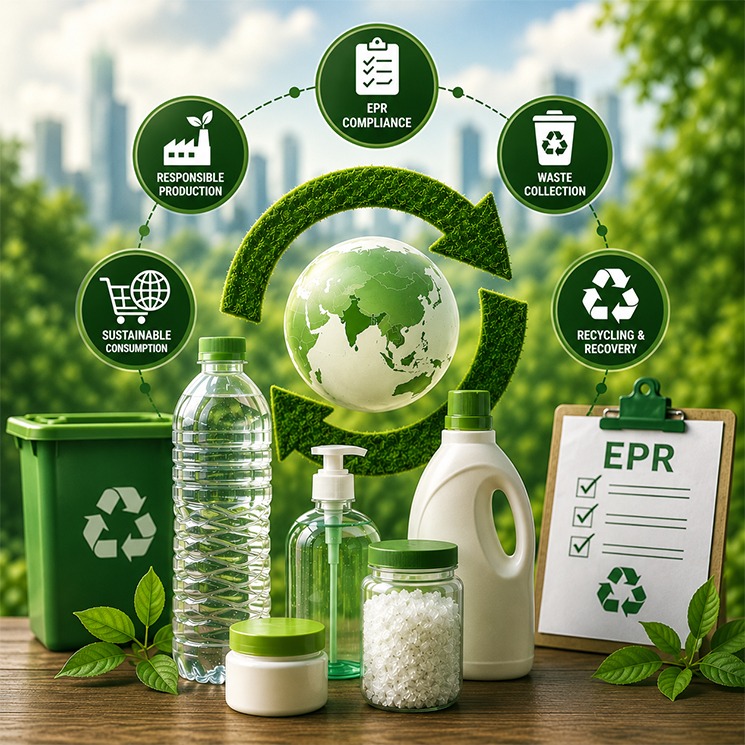
As India moves toward a more sustainable and circular economy, packaging regulations are becoming stricter and more structured than ever before. For brand owners across FMCG, food & beverage, personal care, pharmaceutical, and industrial sectors, understanding Extended Producer Responsibility (EPR) and plastic packaging regulations is no longer optional; it is a critical business requirement.
With evolving compliance mandates, increasing sustainability expectations, and stronger enforcement mechanisms, businesses must proactively prepare for the future of responsible packaging.
Understanding Extended Producer Responsibility (EPR)
Extended Producer Responsibility (EPR) is a government-led framework under India’s Plastic Waste Management Rules that makes Producers, Importers, and Brand Owners (PIBOs) responsible for the collection, recycling, and environmentally sound management of plastic packaging introduced into the market.
The primary objective of EPR is to strengthen plastic waste management systems, improve recycling rates, and reduce environmental impact through a more circular packaging ecosystem.
For businesses, this means packaging responsibility now extends beyond manufacturing and distribution; it also includes post-consumer waste management.
Why EPR Compliance Is Becoming More Important in 2026
India’s packaging industry is witnessing a major regulatory shift driven by sustainability goals and environmental accountability. In 2026, stricter implementation and monitoring of plastic waste management rules are expected across industries.
For brand owners, non-compliance can lead to:
- Regulatory penalties
- Operational disruptions
- Challenges in market expansion
- Increased scrutiny from retailers and export markets
- Negative impact on brand reputation
At the same time, businesses investing in sustainable packaging and recycling initiatives are building stronger consumer trust and long-term competitiveness.
Key Plastic Packaging Rules Brand Owners Must Know
Mandatory EPR Registration
All Producers, Importers, and Brand Owners dealing with plastic packaging are required to register on the Central Pollution Control Board (CPCB) EPR portal.
Without proper registration and reporting, businesses may face compliance-related restrictions and legal challenges.
Recycling & Collection Targets
Companies are required to ensure that an equivalent quantity of plastic packaging introduced into the market is collected and processed through authorized recycling or waste management channels.
The government continues to increase recycling obligations gradually to improve plastic recovery and reduce landfill dependency.
This has made partnerships with authorized recyclers and sustainable packaging manufacturers increasingly important.
Importance of Traceability & Documentation
Regulatory compliance now requires better transparency and documentation throughout the packaging lifecycle.
Businesses are expected to maintain proper records related to:
- Packaging material introduced into the market
- Waste collection and recycling certificates
- Authorized recycler partnerships
- Recycled content utilization
Digital tracking and reporting systems are becoming essential for smooth EPR compliance management.
Preparing for the Future of Responsible Packaging
For modern businesses, EPR compliance should not be viewed only as a legal obligation. It is an opportunity to strengthen sustainability strategies, improve packaging efficiency, and build long-term brand value.
Brand owners who proactively adapt to evolving packaging regulations today will be better positioned to:
- Meet future compliance requirements
- Build stronger consumer trust
- Improve sustainability performance
- Strengthen retailer and export partnerships
- Enhance overall business resilience
Conclusion
India’s packaging industry is entering a new phase where sustainability, compliance, and accountability are becoming deeply interconnected. As regulations continue to evolve, businesses must take proactive steps toward responsible packaging practices and stronger waste management systems.
Understanding EPR requirements today will help brand owners build future-ready operations while improving long-term sustainability performance and market competitiveness.
In Part 2, we explore how sustainable PET packaging, recycled content integration, and circular packaging strategies can help brands meet evolving EPR goals and future compliance requirements.