
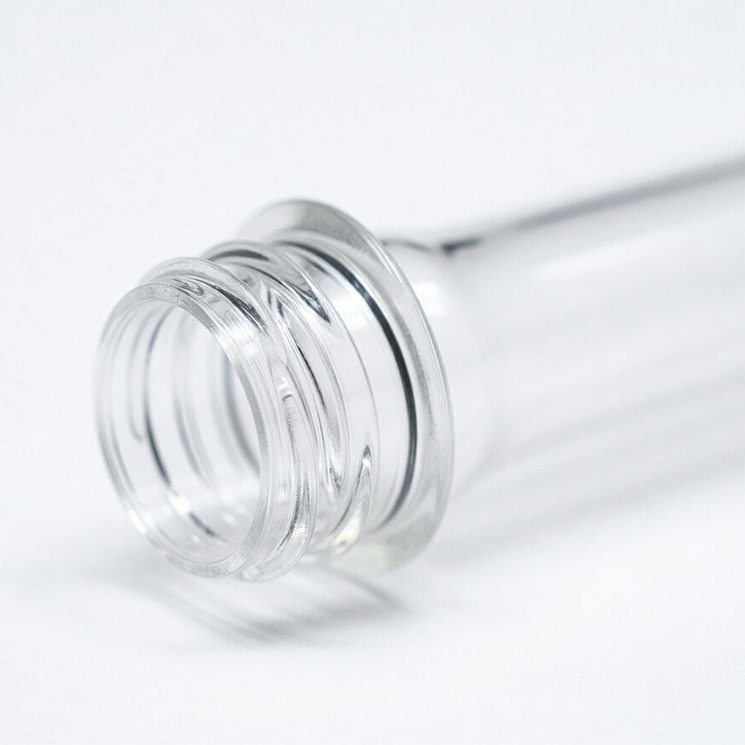
In high-volume beverage and liquid packaging, filling line efficiency depends on more than machine speed. It is also shaped by the consistency and design of the PET preform moving through the line. A preform that looks acceptable on paper can still create issues during blowing, filling, capping, and downstream handling if the design is not aligned with production conditions.
For brands and bottlers, this matters because even small variations can lead to unstable processing, higher rejection rates, unnecessary downtime, and avoidable material loss. PET preform design is not only about achieving the final bottle shape. It plays a direct role in how smoothly the entire packaging line performs.
Why preform design matters on the line
A PET preform is the starting point of the bottle-making process. Its dimensions, neck finish, wall distribution, weight, and resin behaviour all influence how the bottle forms and how it behaves once it reaches the filling line.
When preforms are designed correctly, they support stable blowing, consistent bottle performance, accurate filling, and reliable capping. When the design is poorly matched to the application, bottlers often face recurring problems such as bottle distortion, inconsistent neck dimensions, cap leakage, line jams, and product rejection.
In fast-moving operations, these issues quickly affect output.
Neck finish accuracy and capping performance
One of the most important areas in preform design is the neck finish. This section must remain dimensionally precise because it directly affects cap fit, sealing integrity, and torque consistency.
If the neck finish varies even slightly, the capping system can struggle to apply closures correctly. This may result in loose caps, over-torquing, leakage, or bottles being rejected during quality checks. In sectors such as water, edible oil, dairy, and pharmaceuticals, sealing performance is critical not only for line efficiency but also for product safety and shelf life.
Consistent neck finish design helps maintain reliable cap application at high speed and reduces stoppages linked to closure-related faults.
Material distribution affects bottle stability
Preform design also determines how material is distributed once the bottle is blown. This affects the bottle’s strength, base performance, panel stability, and resistance to deformation.
If material distribution is uneven, the bottle may become weak in key areas. On a filling line, that can create problems such as bottle wobble, collapse under pressure, poor conveyor movement, or distortion during filling and capping. Lightweight bottles are especially sensitive to this, because the balance between resin reduction and structural performance has to be carefully managed.
A well-designed preform ensures the final bottle has enough strength where it is needed, without creating unnecessary material usage.
Blowing consistency supports downstream efficiency
Filling line performance begins before the product enters the bottle. If the preform does not heat evenly or stretch correctly during blowing, the resulting bottles may vary in shape, thickness, or clarity. That inconsistency affects everything that follows.
Bottles with poor dimensional control may not sit properly on conveyors, may misalign in fillers, or may fail during capping. In automated lines, these variations can reduce speed and increase intervention from machine operators.
Preforms designed for stable thermal behaviour and repeatable blowing performance help create uniform bottles, which in turn support smoother downstream processing.
Weight optimisation must not compromise performance
Many brands aim to reduce packaging weight to lower resin consumption and improve cost efficiency. While this is a valid objective, excessive lightweighting can create line performance issues if the preform is not properly re-engineered.
A preform with insufficient structural support may lead to bottles that flex too easily during rinsing, filling, or transport through the line. This can reduce line speed and increase handling problems. Weight optimisation must be supported by sound design, proper testing, and an understanding of the actual filling environment.
The most effective preforms are not simply lighter. They are designed to use material efficiently while still delivering reliable performance.
Gate quality and appearance control
The gate area at the base of the preform also matters more than many people realise. Poor gate design or inconsistent gate finishing can influence bottle formation, visual quality, and even stress distribution.
On fast lines, any variation that affects bottle uniformity can contribute to rejection or operational inefficiency. For premium packaging formats, appearance is also part of performance. A bottle that fills correctly but looks inconsistent still creates a commercial problem.
Preform design must therefore support both process stability and final pack quality.
Matching the preform to the product category
Different products place different demands on a PET bottle, which means the preform design must be tailored accordingly. A water bottle, a carbonated soft drink bottle, an edible oil container, and a pharma pack do not require the same design logic.
For example, carbonated beverages need pressure resistance, while edible oil packaging may require better panel strength and controlled pouring performance. Dairy and sensitive liquid applications may place more emphasis on barrier properties, hygiene standards, and hot-fill or warm-fill considerations where relevant.
Using a standard preform across multiple applications may seem efficient, but it often limits performance. A preform designed for the actual product, bottle format, and line conditions usually delivers better operational results.
Consistency is just as important as design
Even a strong design will not perform well if manufacturing consistency is poor. Filling line efficiency depends on receiving preforms that are uniform from batch to batch. Variation in weight, dimensions, moisture control, or resin quality can disrupt blowing performance and bottle handling.
This is why preform quality control is closely linked to line productivity. Reliable supply, tight tolerances, and repeatable manufacturing standards help bottlers maintain output without frequent adjustments.
The wider business impact
When preform design supports line efficiency, the benefits go beyond production metrics. Businesses can see lower rejection rates, reduced downtime, better closure performance, improved bottle integrity, and more predictable output. Over time, this improves cost control and helps maintain packaging quality in the market.
In contrast, poorly optimised preforms can increase hidden costs across the operation. These include machine stoppages, wasted product, excess operator intervention, and customer complaints linked to leakage or bottle failure.
Final thoughts
PET preform design has a direct effect on filling line efficiency because it shapes how the bottle performs at every stage of processing. From blowing consistency and neck finish accuracy to structural strength and capping reliability, the design of the preform influences both operational speed and pack quality.
For packaging operations focused on scale, consistency, and cost control, the right preform is not a minor component. It is a critical part of line performance. Businesses that invest in well-engineered, application-specific PET preforms are better placed to improve productivity and reduce avoidable losses across the packaging cycle.