
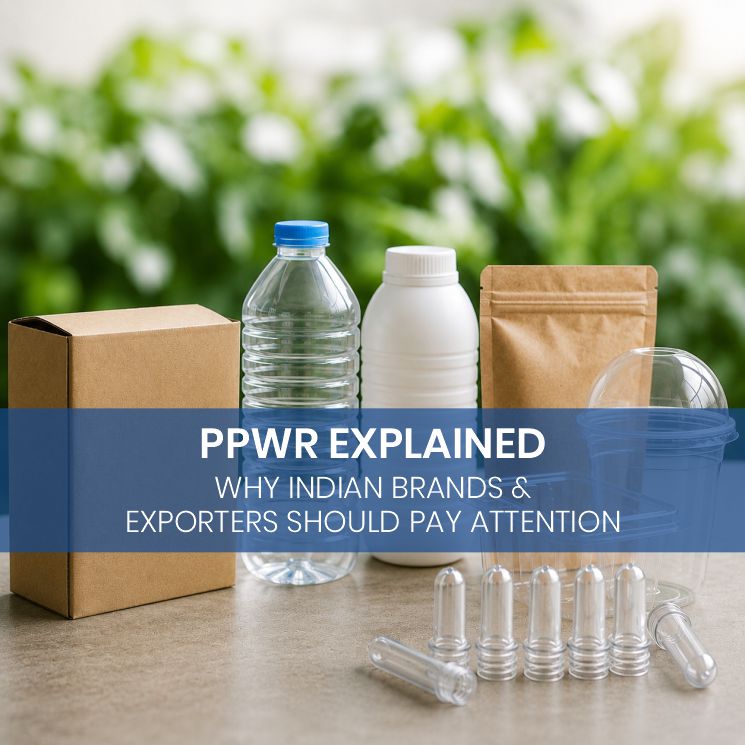
The packaging industry is evolving faster than ever. Around the world, governments are introducing new regulations to reduce packaging waste, improve recyclability, and encourage the use of more sustainable materials.
In India, businesses are already adapting to initiatives such as the Plastic Waste Management (PWM) Rules and Extended Producer Responsibility (EPR). Meanwhile, the European Union has introduced one of its most significant packaging regulations to date—the Packaging and Packaging Waste Regulation (PPWR).
Although PPWR is a European regulation, its influence extends beyond Europe. For Indian manufacturers, exporters, and brands supplying international markets, understanding PPWR can help businesses stay informed about emerging global packaging trends and evolving customer expectations.
In this blog, we’ll explain what PPWR is, why it matters, and what businesses should know.
What Is PPWR?
The Packaging and Packaging Waste Regulation (PPWR) is the European Union’s legislative framework for packaging and packaging waste.
It was adopted in December 2024, entered into force on 11 February 2025, and generally applies from 12 August 2026, with several requirements being introduced in phases over the coming years.
Unlike the earlier Packaging and Packaging Waste Directive (PPWD), adopted in 1994, PPWR applies directly across all 27 EU Member States, creating a more harmonised approach to packaging requirements.
Its objective is to reduce packaging waste while encouraging packaging that supports a more circular economy.
Why Should Indian Businesses Care?
At first glance, PPWR may appear relevant only to companies operating in Europe.
However, many Indian businesses are closely connected to global supply chains.
PPWR may be relevant if your business:
- Exports products to European markets
- Manufactures packaging for international brands
- Supplies multinational FMCG or beverage companies
- Plans to expand into global markets
- Wants to stay ahead of evolving packaging trends
Even businesses that don’t currently export may notice increasing customer expectations around packaging design, recyclability, and responsible material use as global brands align with international standards.
What Is PPWR Trying to Achieve?
Rather than focusing solely on packaging waste, PPWR considers the entire lifecycle of packaging.
Its objectives include:
- Encouraging packaging that is designed for recyclability
- Increasing the use of recycled content in certain plastic packaging applications
- Reducing unnecessary packaging and excess material
- Supporting reuse and refill systems where appropriate
- improving consistency in labelling and producer responsibilities across the European Union
The overall aim is to improve resource efficiency while ensuring packaging continues to protect products and perform its intended function.
What Does This Mean for Packaging?
One of the biggest changes introduced by PPWR is a shift in how packaging is evaluated.
Traditionally, packaging decisions focused on:
- Product protection
- Manufacturing efficiency
- Cost
- Shelf appeal
Today, businesses are increasingly asking additional questions:
- Can this packaging be effectively recycled?
- Can unnecessary material be reduced?
- Can recycled content be incorporated where appropriate?
- Does the packaging support a circular economy?
These considerations are becoming an increasingly important part of packaging design and product development.
What Does This Mean for PET Packaging?
PET continues to be one of the world’s most widely used packaging materials due to its strength, lightweight properties, clarity, and well-established recycling infrastructure.
As regulations such as PPWR encourage circular packaging solutions, businesses are placing greater emphasis on:
- Designing PET packaging for effective recycling
- Responsible lightweighting without compromising performance
- Increasing the use of recycled PET (rPET), where appropriate
- Improving compatibility across packaging components such as bottles, closures, and labels
These are areas where packaging innovation will continue to play an important role.
Preparing for the Future
Whether your business exports today or plans to in the future, staying informed about global packaging developments can help you make better long-term decisions.
Questions worth considering include:
- Is our packaging designed with recyclability in mind?
- Can we optimise material use without affecting product performance?
- Are we exploring opportunities to incorporate recycled content where appropriate?
- Are we keeping pace with evolving customer and regulatory expectations?
- Are we collaborating with packaging partners who understand future industry trends?
Taking a proactive approach today can help businesses adapt more confidently to tomorrow’s packaging landscape.
Final Thoughts
PPWR is more than a European regulation—it reflects a broader global shift towards smarter packaging design, resource efficiency, and circularity.
For Indian manufacturers, exporters, and brand owners, understanding regulations such as PPWR is not simply about compliance. It is about recognising where the packaging industry is heading and preparing for changing market expectations.
At Chemco Group, we believe that sharing knowledge is an important part of building better packaging solutions. Through our educational blog series, we aim to simplify industry developments and help businesses navigate the future of packaging with confidence