
India’s menstrual-care market is growing, but it remains heavily dominated by conventional products.
According to Mordor Intelligence, India’s feminine hygiene products market is estimated at US$1.32 billion in 2026 and is projected to reach approximately US$2.29 billion by 2031, growing at a CAGR of 11.67%.
Sanitary napkins continue to account for the overwhelming majority of the market, while reusable products are expected to grow faster over the forecast period.
For menstrual-cup brands, this presents an interesting opportunity.
The opportunity is not simply to launch another menstrual cup. It is to reach the next consumer.
The Gap Between Awareness and Adoption
A 2024 systematic review and meta-analysis covering 18 studies on reproductive-age women in India reported a pooled menstrual-cup usage prevalence of approximately 5% among the populations studied. Importantly, 62% of non-users included in the studies expressed willingness to use a menstrual cup in the future.
These figures should not be interpreted as India’s national menstrual-cup penetration rate. They are pooled estimates from the studies reviewed.
However, they highlight an important business question:
What will encourage potential users to become actual users?
For brands, the answer may lie in developing products that address different consumer requirements rather than treating the menstrual cup as a one-size-fits-all category.
Product Development Can Drive Market Expansion
As the category develops, brands can differentiate through:
- Size and shape
- Flexibility
- Rim geometry
- Stem design
- Material
- Surface characteristics
- Packaging and instructions
The objective is not simply to add features. It is to develop a clear product proposition for a defined consumer group.
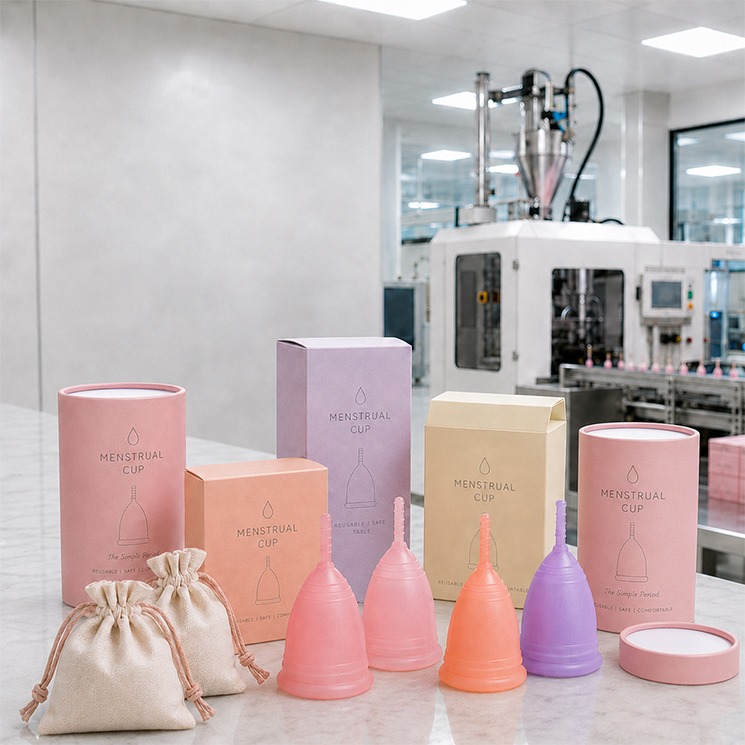
Chemco supports customisation of menstrual-cup designs, including size, shape, rim geometry, softness and flexibility, surface texture, stem design and logo placement.
From Product Concept to Commercial Scale
Developing a menstrual cup is one challenge. Manufacturing it consistently at commercial scale is another.
Key considerations include:
- Material selection
- Product geometry
- Moulding parameters
- Process control
- Product consistency
- Quality testing
Chemco manufactures menstrual cups using medical-grade silicone and Liquid Silicone Rubber (LSR) injection moulding technology. Its menstrual-cup manufacturing facility is ISO 13485 certified and operates controlled cleanroom environments.
For a growing brand, the manufacturing partner needs to offer more than production capacity.
It needs to support consistency, quality and scalability.
Why Contract Manufacturing Can Make Sense for Brands
For a new menstrual-cup brand, establishing manufacturing infrastructure internally can require significant investment in:
- Equipment
- Tooling
- Quality systems
- Technical expertise
- Production facilities
Contract manufacturing offers another route.
The brand can focus on:
Brand building → Consumer education → Distribution → Market development
While the manufacturing partner supports:
Product development → Tooling → Manufacturing → Quality → Scale-up
What Should Brands Look for in a Manufacturing Partner?
Price is only one part of the decision.
Brands should consider:
- Product development — Can the manufacturer support custom designs?
- Material expertise — Does it understand the relationship between material, flexibility and product geometry?
- Quality systems — Are materials, production and finished products controlled consistently?
- Manufacturing capability — Can the product be manufactured at the required scale?
- Customisation — Can the manufacturer support different sizes, designs and branding requirements?
- Scalability — Can production capacity grow alongside the brand?
These questions shift the conversation from:
“Who can manufacture our menstrual cup?”
to:
“Who can support the growth of our menstrual-cup brand?”
The Opportunity Ahead
India already has a large and growing feminine-hygiene market. Yet conventional products continue to dominate, while menstrual-cup adoption remains relatively low among the populations studied.
For brands, this creates room to build the category further through:
- Better product propositions
- Consumer education
- Accessibility
- Product differentiation
- Scalable manufacturing
The next phase of menstrual-cup growth may depend not only on how many brands enter the market, but on how effectively those brands develop products for consumers who have not yet made the switch.
At Chemco Group, menstrual-cup contract manufacturing combines product customisation, medical-grade silicone, LSR technology, quality systems and scalable manufacturing capabilities.
Because scaling a menstrual-cup brand starts long before the product reaches the shelf—it starts with having the right manufacturing partner behind it.