Launching a Baby Care Brand? 7 Things to Know Before Choosing a Contract Manufacturer

Launching a baby care brand is exciting, but turning an idea into a market-ready product involves more than choosing a design and finding someone to manufacture it.

There are decisions around materials, product design, moulds, manufacturing, testing, quality and packaging. And because baby care products are used by infants, these decisions need to be taken seriously from the very beginning.

This is where choosing the right contract manufacturing partner can make a difference.

A good manufacturing partner should do more than produce your product. They should understand your requirements, help you address manufacturing challenges and have the capabilities to support you as your brand grows.

Here are seven things to consider before choosing one.

1. Look Beyond Production Capacity

Having enough machines and production capacity is important, but it should not be the only thing you look at.

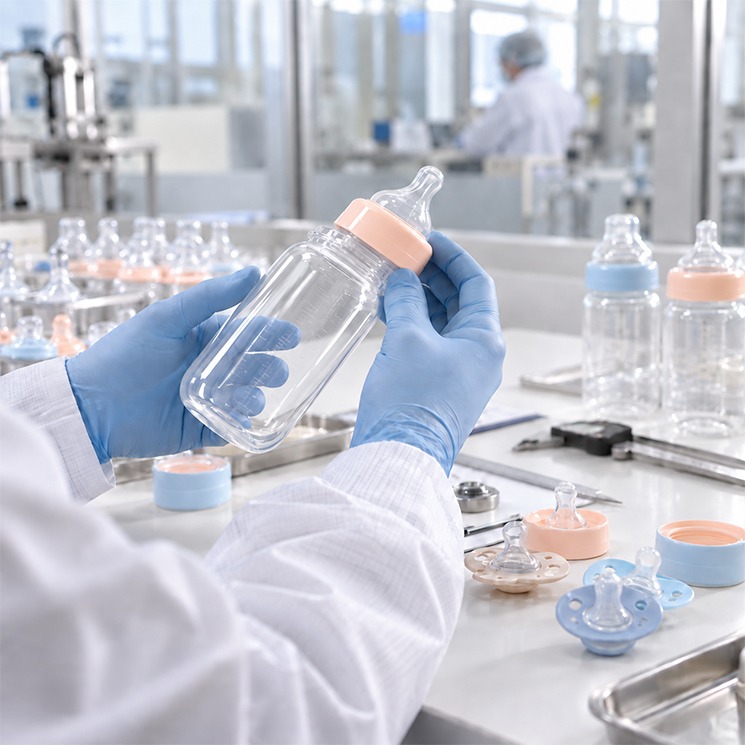
Baby care manufacturing can involve several stages, from product development and engineering to mould development, manufacturing, testing, assembly and packaging.

If you need a different supplier for every stage, managing the development process can become complicated.

Instead, look for a manufacturer who can support more of the product journey.

Ask:

  • Can they support product development and customisation?
  • Do they have engineering and tooling capabilities?
  • What manufacturing technologies do they have?
  • Can they manufacture different baby care components?
  • Can they support higher volumes as your brand grows?

The right partner should understand not just how to produce the product, but also what it takes to produce it consistently.

2. Understand the Materials Being Used

Material selection is an important part of baby care product development.

A feeding bottle, nipple, soother or sipper may have very different functional requirements. The material needs to be selected based on the product’s design, application and intended use.

Before finalising a manufacturer, ask:

  • What material will be used for each component?
  • Is the material suitable for the intended application?
  • What grade of material is being used?
  • How is the raw material inspected?
  • What documentation can be provided?

For example, Chemco uses virgin-grade polypropylene and USFDA-approved medical-grade Liquid Silicone Rubber (LSR) for its baby care products, depending on the application.

It is better to have these conversations early. Changing materials later can affect product design, moulds, processing and even production timelines.

3. Look Closely at Quality and Compliance

For baby care products, quality cannot be treated as something that happens only at the end of the production line.

A reliable manufacturing process should include checks at different stages, starting with raw materials and continuing through production and finished-product inspection.

When evaluating a manufacturer, ask how they manage:

  • Raw material inspection
  • Process controls
  • In-process quality checks
  • ⁠Product testing
  • ⁠Batch traceability
  • ⁠Internal audits
  • Non-conforming products

You should also understand which standards and certifications apply to the product you are developing.

Chemco’s baby feeding bottles and nipples are certified to EN 14350:2020 requirements, and its baby feeding bottles and nipples have BIS 3565 certification. The facility also includes a dedicated laboratory for quality and product testing.

Instead of simply asking, “Are you certified?”, ask:

“Which standards does my product need to meet, and how do you maintain these requirements during production?”

That will give you a much better understanding of the manufacturer’s quality systems.

4. Don’t Underestimate the Importance of the Mould

When developing a new baby care product, it is easy to focus on the final product and overlook the mould behind it.

But mould design can have a direct impact on product dimensions, wall thickness, weight, component fit, surface finish and production consistency.

This becomes even more important when developing a customised product.

A manufacturer with engineering and tooling expertise should be able to identify potential manufacturing challenges before the mould is finalised.

For example, a design may look good on paper but create difficulties during production. Addressing such issues early is much easier than making changes after the mould has already been manufactured.

The earlier the manufacturer is involved, the easier it is to identify and solve these challenges.

5. Ask What Happens Between the First Sample and Mass Production

Getting one good sample is not the same as consistently manufacturing thousands of products.

This is an important difference to consider when choosing a contract manufacturer.

During development, you may go through several rounds of sampling before the final design is approved. But once production starts, the focus shifts to maintaining the same quality across every batch.

Ask your manufacturer:

  • What testing is carried out during development?
  • What checks are performed during production?
  • How are dimensions and weight controlled?
  • How is product consistency monitored?
  • What happens if a product does not meet the required specifications?

The objective should be simple: the product you receive in your next production batch should perform and look like the one you approved.

6. Think Beyond Manufacturing

Your product does not necessarily go straight from the production line to the customer.

Depending on your business model, you may also need assembly, printing, labelling and packaging.

Having these capabilities with the same manufacturing partner can make the overall supply chain easier to manage.

Chemco’s baby care capabilities include manufacturing, assembly, multi-colour pad and screen printing and packaging. Its facility also includes dedicated storage and controlled production areas.

This does not mean that every brand needs one supplier to handle everything. But understanding the complete range of services available can help you decide how you want to structure your supply chain.

7. Choose a Partner That Can Grow With Your Brand

Your manufacturing requirements can change considerably as your brand grows.

You may start with one feeding bottle and eventually introduce different sizes, nipples, sippers, soothers or other baby care products.

That is why scalability is worth discussing before you sign an agreement.

Look at:

  • Current production capacity
  • Minimum order quantities
  • Lead times
  • Available manufacturing technologies
  • Ability to increase production volumes
  • Quality systems at higher volumes
  • Ability to develop additional products

A manufacturer that works well for your first order may not necessarily be the right partner when your volumes increase.

Ideally, you want a partner who can support both your launch and your next stage of growth.

What Should You Ask a Baby Care Contract Manufacturer?

Before making a decision, it can help to compare manufacturers using the same set of questions.

Product Development
Can you support product development and customisation?

Materials
What materials and grades are available for our application?

Tooling
Who will manage mould development and modifications?

Manufacturing
What technologies and production capabilities do you have?

Quality
What quality checks are carried out during production?

Compliance
Which applicable standards and certifications does the product meet?

Testing
What testing facilities are available?

Finishing
Can you support printing, assembly and packaging?

Scalability
Can you support higher production volumes as our brand grows?

The answers can help you understand whether you are simply choosing a supplier or building a longer-term manufacturing relationship.

The Chemco Perspective

At Chemco, we believe baby care manufacturing starts well before the production line.

Product design, material selection, tooling, manufacturing, quality control and packaging all play a role in developing a consistent, market-ready product.

Chemco has been working with baby care brands for over 30 years and offers manufacturing support across feeding bottles, nipples, soothers and pacifiers, sippers and training sets, breast pumps and other baby care accessories.

The facility includes dedicated raw material and finished goods storage, controlled production areas, cleanrooms, testing facilities and specialised equipment for different baby care components.

For a new or growing baby care brand, the right contract manufacturing partner can help make product development more structured, production more consistent and scaling easier.

Because ultimately, choosing a manufacturer is not just about where your product is made.

It is about the expertise, processes and quality systems behind every product that reaches a customer.

What Makes Pharmaceutical Packaging Different From Standard Packaging?

A bottle may look simple from the outside. But when that bottle is used for a pharmaceutical product, there is much more to consider than its shape, size or appearance.

Pharmaceutical packaging has to work with the product inside, protect it during its shelf life, perform reliably through filling and transportation, and meet the quality and documentation requirements of the pharmaceutical industry.

This is why a bottle that works well for one application cannot automatically be considered suitable for another.

So, what actually makes pharmaceutical packaging different?

It Starts With the Product Inside

The first question in pharmaceutical packaging should not be “Which bottle should we use?”

It should be “What does the product need from its packaging?”

A cough syrup, dry syrup, suspension or other pharmaceutical formulation can have different packaging requirements.

The formulation may influence the choice of:

  • Packaging material
  • Bottle size and shape
  • Colour
  • Barrier requirements
  • Closure system
  • Dispensing format
  • Shelf-life requirements

For example, some formulations may require greater protection from light, while others may have specific compatibility or moisture-related requirements.

This is why pharmaceutical packaging is usually developed around the product rather than simply selected from a standard packaging catalogue.

Material Selection Is More Than a Cost Decision

For any packaging application, material selection affects performance. In pharmaceuticals, there are additional considerations around compatibility and product protection.

PET is widely used for pharmaceutical bottles because it offers a combination of clarity, strength, lightweighting potential and processing flexibility.

But choosing PET is only the beginning.

Packaging teams need to consider whether the selected material and construction are appropriate for the formulation and its intended shelf life.

Questions around chemical compatibility, barrier performance, colour, weight and processing conditions can all become important during development.

The material should therefore be selected based on what the formulation requires, not simply what is readily available.

Barrier Properties Can Affect Product Protection

A pharmaceutical product may be exposed to oxygen, moisture, light or other environmental conditions during storage and distribution.

The packaging is expected to provide an appropriate level of protection against these factors.

This is where barrier properties become important.

The required level of barrier protection depends on the formulation, shelf life, storage conditions and packaging design.

In some applications, standard PET may provide the required performance. In others, packaging may need additional barrier considerations or a different construction.

The important point is that barrier performance should be evaluated against the product requirement.

More barrier is not automatically better. The objective is to provide the level of protection the product actually needs.

The Bottle and Closure Need to Work Together

A pharmaceutical bottle is not a complete packaging system on its own.

The closure plays an equally important role.

Bottle neck dimensions, closure compatibility, sealing performance and the filling process all need to work together. A good bottle design can still create problems if the closure does not provide the required fit or sealing performance.

This is particularly important for pharmaceutical products where maintaining product integrity throughout storage and use is essential.

Chemco’s pharmaceutical range includes PET bottles designed for different closure systems, including ROPP caps and overcaps, depending on the bottle format and application.

That is why packaging development should consider the bottle, neck finish and closure as one system, rather than three separate decisions.

Packaging Also Has to Work on the Filling Line

A packaging sample may look perfect on a table. The real test begins when it goes onto a production line.

Pharmaceutical bottles need to work with the customer’s filling, capping, labelling and handling equipment.

Small variations in bottle dimensions, weight, neck finish or stability can affect machine performance and line efficiency.

This is where manufacturing consistency becomes important.

A packaging supplier needs to be able to produce the approved design repeatedly, within the required specifications.

At Chemco, durability and dimensional accuracy are among the key criteria used to evaluate packaging products, supported by quality checks throughout the manufacturing process.

Consistency Matters More Than One Good Sample

One of the easiest things to overlook during packaging development is the difference between approving a sample and maintaining quality at scale.

A pharmaceutical brand may require thousands or millions of bottles over the life of a product.

The bottle supplied in the next batch needs to remain consistent with the one that was approved.

This means manufacturers need appropriate process controls and quality checks covering factors such as:

  • Dimensions
  • Weight
  • Neck finish
  • ⁠Visual quality
  • Material characteristics
  • Bottle performance

Consistency is particularly important because even small variations can create issues during filling, capping or downstream packaging operations.

Manufacturing Controls and Standards Matter

Pharmaceutical customers need confidence not only in the finished packaging, but also in the systems and processes used to manufacture it.

Depending on the application and customer requirements, this can involve controlled manufacturing environments, quality systems, traceability, change control and supporting documentation.

This is where standards specifically related to pharmaceutical packaging become important.

ISO 15378 is a quality management standard specifically focused on primary packaging materials for medicinal products. It incorporates the principles of ISO 9001 along with Good Manufacturing Practice (GMP) requirements relevant to pharmaceutical packaging.

For a packaging manufacturer, working to this type of standard means that quality and GMP considerations are built into the manufacturing and quality-management approach, rather than being treated only as a final product check.

Chemco is ISO 15378 certified, along with operating pharmaceutical packaging manufacturing under GMP and ISO-certified systems. This supports the quality, traceability and process-control requirements expected by pharmaceutical customers.

For pharma brands, the manufacturer’s standards and quality systems are therefore an important part of the supplier evaluation process.

Standard Packaging vs Pharmaceutical Packaging

The difference becomes clearer when we look at what each packaging solution needs to achieve.

This does not mean that every pharmaceutical package needs to be highly complex.

In fact, the best solution may be a relatively simple bottle.

What matters is whether the packaging is right for the product and the process.

What Should Pharma Brands Consider Before Selecting a Packaging Supplier?

Before finalising a pharmaceutical packaging supplier, it is useful to look beyond the product catalogue and quotation.

Consider:
Product compatibility
Is the material and packaging construction appropriate for the formulation?
Protection
Does the packaging provide the required protection against environmental factors?
Closure compatibility
Will the bottle and closure work together effectively?
Filling-line performance
Has the packaging been designed to work with the customer’s filling and capping process?
Manufacturing consistency
Can the supplier maintain the same specifications across production batches?
Quality systems
What standards, checks and controls are in place during manufacturing?
Documentation and traceability
Can the supplier provide the quality and manufacturing documentation required for the application?

These questions can help brands evaluate a packaging supplier based on overall capability, rather than simply comparing bottle prices.

The Chemco Perspective

Pharmaceutical packaging sits at the intersection of product protection, packaging design and manufacturing performance.

At Chemco, our pharmaceutical packaging range includes PET bottles in different shapes, capacities, colours and neck finishes for applications including cough syrups, dry syrups and other pharmaceutical and personal care products.

Our pharmaceutical bottle range includes formats such as 60ml, 100ml and 200ml bottles, manufactured using Injection Stretch Blow Moulding (ISBM) technology, with options including translucent, white and amber depending on the product and packaging requirement.

Chemco is also ISO 15378 certified, supporting its focus on quality management and GMP requirements for primary packaging materials used with medicinal products.

But the right pharmaceutical packaging solution is not simply about choosing a bottle from a catalogue.

It is about understanding the formulation, protection requirements, material, closure, filling process and manufacturing requirements and bringing these factors together in one packaging solution.

Because in pharmaceutical packaging, the bottle may be the most visible part of the package — but the decisions and quality systems behind it are what make it work.

PET Preform Defects: What They Mean and What Causes Them?

A PET preform may look like a simple intermediate component, but it plays an important role in the performance of the final PET bottle.

Before the bottle is formed through stretch blow moulding, the preform already determines key characteristics such as weight, geometry, neck dimensions and material distribution. Any variation in these areas can influence how the PET behaves during the bottle-making process.

This is why understanding preform defects is important for both PET bottle manufacturers and packaging brands.

What Is a PET Preform Defect?

A PET preform defect is any deviation from the required appearance, dimensions, weight, material distribution or physical characteristics of the preform.

Some defects are visible during inspection, while others may only become apparent during stretch blow moulding or in the finished bottle.

The cause can originate at different stages—from resin handling and drying to injection moulding, cooling and mould maintenance.

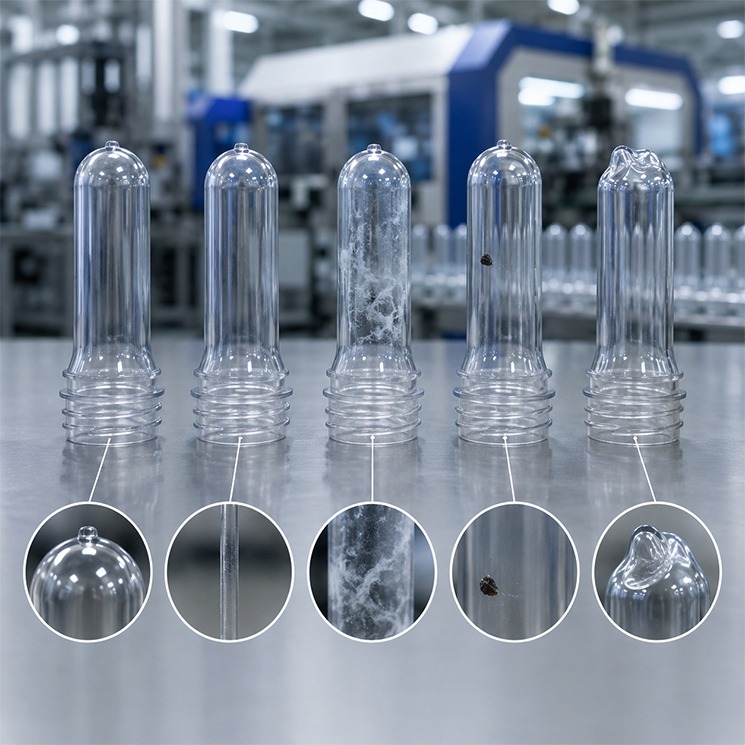
1. Black Specks or Dark Particles

Black specks appear as small dark particles or discoloured areas within the preform.

Possible causes include:

* Material degradation
* Excessive residence time
* Contamination
* Degraded PET in the injection system
* Poor equipment cleanliness

Because PET can degrade when exposed to excessive heat for extended periods, controlling processing conditions and residence time is important.

2. Haze or Cloudiness

Haze can affect the clarity and appearance of a PET preform.

Possible causes include:

* Insufficient resin drying
* Moisture-related degradation
* Incorrect processing conditions
* Excessive crystallisation
* Contamination

PET is hygroscopic, meaning it can absorb moisture from the environment. Proper resin drying before processing is therefore an important part of preform manufacturing.

3. Short Shots

A short shot occurs when the mould cavity is not completely filled, resulting in incomplete preform geometry.

Possible causes include:

* Insufficient injection pressure
* Incorrect injection speed
* Inadequate melt temperature
* Material flow restrictions
* Incorrect process settings

A short shot can affect both the dimensions and subsequent performance of the preform.

4. Flash

Flash is excess PET extending beyond the intended moulded geometry, commonly around the mould parting line.

It may be associated with:

* Excessive injection pressure
* Mould wear or damage
* Incorrect clamping conditions
* Mould misalignment
* Process instability

Flash can affect dimensional consistency and may require additional inspection or corrective action.

5. Dimensional Variation

Consistency in preform dimensions is particularly important around the neck finish, which must interface correctly with the closure and filling system.

Variation can occur in:

* Neck dimensions
* Preform length
* Weight
* Wall thickness
* Gate area

Potential contributors include mould condition, process settings, material variation and cooling behaviour.

6. Gate-Related Defects

The gate is where molten PET enters the mould cavity, making it an important area for inspection.

Issues can include:

* Uneven gate appearance
* Excessive gate vestige
* Gate protrusion
* Cracking or damage
* Improper gate formation

Gate quality can affect the appearance of the preform and its behaviour during subsequent stretch blow moulding.

Why Preform Quality Matters to the Final Bottle

The preform becomes the starting material for the finished PET bottle.

During stretch blow moulding, it is reheated and stretched in different directions. Its weight, geometry, wall distribution and material characteristics influence how the material distributes across the final bottle.

For example, inconsistent material distribution can contribute to uneven bottle walls, while variation in the neck area can create downstream compatibility issues.

Therefore, preform inspection should not be considered separately from bottle performance.

How Can Preform Defects Be Reduced?

Consistent preform quality starts with controlling the complete manufacturing process.

Key areas include:

  • Resin handling: Proper storage and handling help minimise contamination and moisture exposure.
  • Resin drying: Correct drying is essential because moisture can affect PET during melt processing.
  • Injection moulding: Temperature, pressure, injection speed, cooling and residence time need to be controlled according to the product and process requirements.
  • Mould maintenance: Mould alignment, cavities, gates and cooling systems can influence preform consistency.
  • Quality inspection: Regular inspection helps identify deviations before they become larger production issues.

What Should PET Buyers Look For?

When selecting a PET preform supplier, price and preform weight should not be the only considerations.

Brands and bottle manufacturers should also evaluate:
* Dimensional consistency
* Neck-finish accuracy
* Weight tolerance
* Visual quality
* Gate quality
* Material consistency
* Process controls
* Quality inspection
* Batch-to-batch consistency

A preform should not only meet a specification on paper. It should consistently perform in the customer’s bottle-production process.

From Preform Quality to Bottle Performance

A PET preform is the foundation of the bottle-making process. Its quality can influence how efficiently and consistently the final bottle is produced.

Understanding common defects therefore helps manufacturers troubleshoot problems earlier and helps packaging buyers make better decisions when evaluating suppliers.

At Chemco Group, PET preform manufacturing focuses on process control, quality consistency and the requirements of the final PET packaging application.

Because better PET bottles start with better-controlled preforms.